Film review
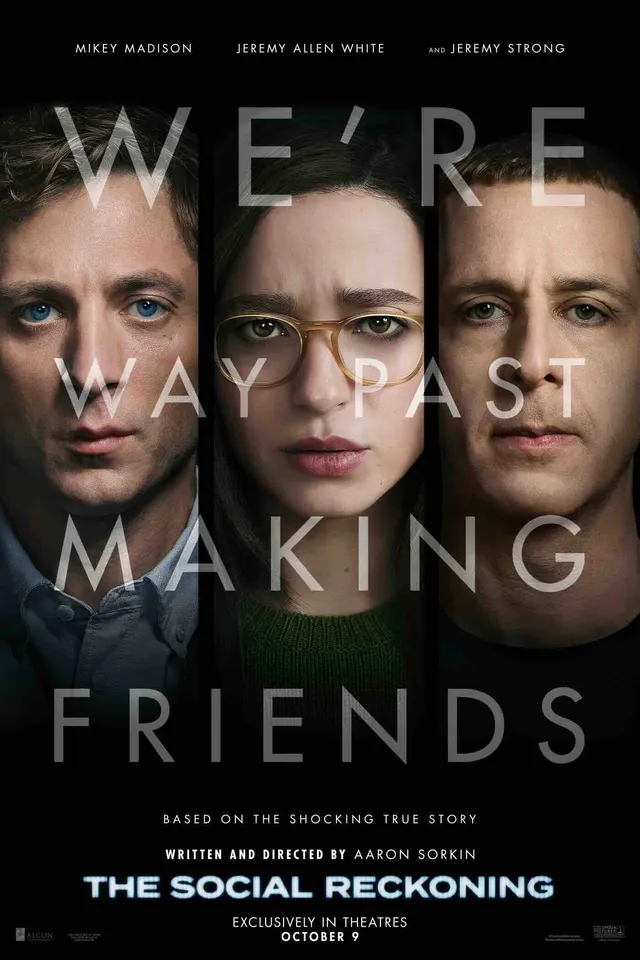
The Social Reckoning
3.5 out of 5 stars
Just like its predecessor, The Social Reckoning is about something important that actually happened: Facebook, and how it’ll be the end of us.
It doesn’t quite reach the same heights, nor is it as enjoyable to watch. To its benefit, it does have some gratifying performances from Jeremy Strong as the Zuck and Bill Burr as some guy I couldn’t be bothered to Google, and it’s trying to shed light on a few critical events that we as the general public should be aware of. I’m not wholly convinced that it’s going to be very effective or attractive to general audiences.
Watching this feels like finding a very prescient news article about four years after it was written; it’s full of numbers and figures that the average reader would be bored or confused by, even though it reports the facts accurately and acceptably. In the end, it just fails to drive home an impactful conclusion. You’re better off for having read it, but you’re not entirely sure you understood it all or what to do now.
Meta confusion
There are lots and lots of numbers, facts, and instances of technical jargon that won’t mean a damn to the average moviegoer who isn’t versed in marketing analytics and data science. It’ll lose a lot of people there. It’s also not cinematically enticing enough, at least to me, to make up for the obfuscation. At the end of the day, the film isn’t actually about the numbers and figures, but about what they represent and their impact on our societal well-being. It’s perhaps just a bit too convoluted to be very effective.
Sorkin chooses a somewhat inconsistent chaptered approach to this tale. I enjoyed that in Weapons last year, and welcomed it when I saw it; the thing is, he kind of starts to play it fast and loose with the rules. There’s several jumps backwards and forwards in time, usually at multiple points within the same chapter. There’s a helpful sort of Apple keynote-esque timeline scroll animation that takes us back and forth through the years, but I found myself having to think about where we were in time as well as in the story, which just added to the list of things I needed to be conscious of. Maybe that’s a me issue; I couldn’t help but feel the “list of things to be thinking about rather than just being immersed in the movie” growing and growing and growing.
But, to play devil’s advocate and because questioning our perspectives is an important exercise in open-mindedness, maybe the technical befuddlement is there precisely to confuse you… and that’s okay? Bear with me here.
First of all, our Wall Street Journal reporter protagonist played by Jeremy Allen White is not a tech reporter; it’s reiterated several times. It’s a clever little screenwriting technique that allows the film to superficially explain what’s happening and why it’s a big deal in layman’s terms. Great! The film is asking you to try and understand its concepts and then literally offering an olive branch if you can’t, which is totally fine because good ol’ Carmy from The Bear can’t either.
It’s almost as “clever” (and frankly a bit truck—my word for something overtly male and testosterone-riddled) as finding the most first-thing-that-came-to-mind justification for putting Mikey Madison in increasingly revealing outfits. She’s in a similar situation in Anora (2024), where she plays an underdog stripper. The difference there is that the costuming is guided by the narrative; here it feels like they squeezed it in to get their money’s worth. The script says it’s her alibi in case anyone spots her whistleblowing at White’s hotel. And while that is, in some way, believable, it’s rather out of character for a mild-mannered and introverted data scientist.
The many inconsistencies add up, and by the time you get to the end, a classic black-and-white freeze-frame statistic dump, you don’t know whether to feel victorious, outraged, or nothing at all.
What’s working in its favor
Its saving grace, in my opinion, is that it’s primarily concerned with addressing how social media by design is resulting in people becoming more radicalized, polarized, and addiction-prone. That tech companies rule the world, that they don’t really care about their users’ well-being if it’s going to cost them dollars and cents.
Oh, by the way, Meta’s current market capitalization (the total value of all its shares) is $1.88 trillion. I’ll write that out for you: 1,880,000,000,000. That’s about 4.36 million football fields in $1 bills. You could count to 1.88 trillion in about 60,000 years.
The film highlights how deeply embedded social media is in our culture and economy. It’s killing print media, gamifying dating, and disseminating the most harmful and radical voices. It perpetuates bullying and has the power to change people’s beliefs.
“You don’t believe in freedom of speech?”
“I do, I just don’t think everyone should have a microphone.”
The film points out that we know next to nothing about these companies’ interior workings. It tells us that they do not have our best interests at heart. They pit everyone from teenagers to soccer moms against each other in the pursuit of ceaseless profit. They’re trying to take as much of your time as possible, feeding you an endless stream of content designed to elicit an emotional response.
Much like Digger, The Social Reckoning is a bit of a downer. I found the former much more enjoyable, but I don’t believe that the latter’s shortcomings should discount what it’s trying to say. They’re both painting a dark picture of the world we live in using various shades of gray.