Film review
Klara and the Sun
3 out of 5 stars
Klara and the Sun tells the story of a simple, quirky, childlike AI robot whose sole purpose is to provide friendship to humans. Overlooked for being an older model “artificial friend” (AF), one day she is fatefully picked to join the family of a “lifted” child (who’s undergone a procedure that artificially increased her intelligence) and her controlling single mother. Living with them, Klara learns what it is to be a friend, a grieving mother, and a person in her own right.
It’s a simple and straightforward story, trying hard to balance sincerity and wit. It just doesn’t always work.
It suffers from the subject matter itself, AI panic and all. There are parts where the Waititi comedy takes more than it gives, and by the end of it I found myself wondering if, fundamentally, the story simply doesn’t lend itself to film as well as it does to the page.
First off, Waititi asks us to empathize with AI, which in the film industry today (and the world at large) is a major point of contention. Generative AI disrupting artists and the creative process is one thing. Portraying AI in your art as a character hoping to attain an emotional response is another. A lot is riding on whether you empathize with Klara or not, and I felt that my fear of the former outweighed my ability to be moved by the latter.
AI characters certainly aren’t new; they’ve fascinated storytellers and filmmakers for decades. Look at Spielberg, Cameron, and the countless other iterations of “smart robots” in sci-fi movies. WALL·E, for god’s sake. What matters to me is being able to empathize with the character, to understand how their motives inform their actions, and whether I think that makes sense.
I think effective portrayals of AI provide the audience with recognizable human mannerisms, dialogue, or iconography they can attribute to the real people in their everyday lives, something that reminds them of a family member or someone they know.
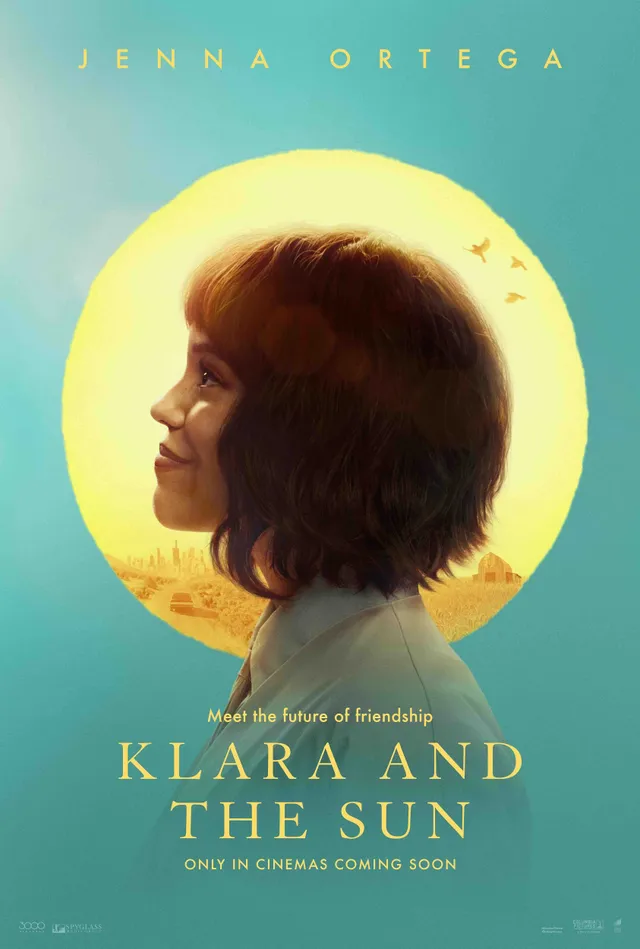
Either this movie is too soon, or it’s ineffective in making Klara resonate with us. I personally felt quite disconnected from the protagonist. Although I know it’s Jenna Ortega, a real human person, I actually believed that she was artificial. Her performance is great, donning lifeless eyes and a clueless, glitchy physicality. Ironically, my praise for her acting is what turns me away from the story.
I may just be suffering from a symptom of the times, one you may share. Lately, I feel I’ve had to adopt a baseline “this which I am seeing could be AI and I wouldn’t know it” skepticism, necessary to navigate even the simplest of digital platforms. I’d like to believe that what I’m seeing is real, but as I swipe up on Instagram I know that Harry Potter dunking on Draco Malfoy in the Great Hall did not happen. I think to myself, if that’s so easily generated, who’s to say it’s not being used to touch up Jenna Ortega’s face? Rationally, I know this is likely not the case. Artistically, I truly hope it’s not. My point is, electing to have her perform in such a way that reminds me “this which I am seeing is AI” (even though it’s acting) brings me right back to skepticism, the last place I want to be while at the cinema.
To a lesser degree, the movie suffers from the same sickness that infected Thor: Love and Thunder (2022). Some moments depicting sincerity were almost immediately played for a laugh, particularly at the very end. Just when it felt like it’d end in a heartfelt way, someone would crack a joke. Then, they’d gear up for another emotional ending just to let one last joke loose. It was a little fatiguing for me. Jojo Rabbit (2019) handled this excellently. This movie, not so much.
Spoilers:
After it was all said and done, I found myself discussing whether the medium of film was even an effective vehicle for the story. Rose made a good point about character motivations: Reading a novel, you can accept the notion of being afraid of a tractor and deciding to blow it up more easily because you’ve established a deeper understanding of the character. When it becomes the conclusion of this movie, it just feels goofy. I agreed with her, the aforementioned tone issues also factoring into the goofiness.
I added that, in a novel, you’d imagine the characters’ likenesses rather than see them with your own eyes. Therefore, I’d argue it’s easier to empathize with the artificial friends in the book, when you can’t actually see what they look like. When it’s Jenna Ortega, a human person being told to become an artificial robot, I think that the contemporary distaste for AI in art muddles what the story tries to convey. Or, at least, how well it says it to me.